
954.826.9172
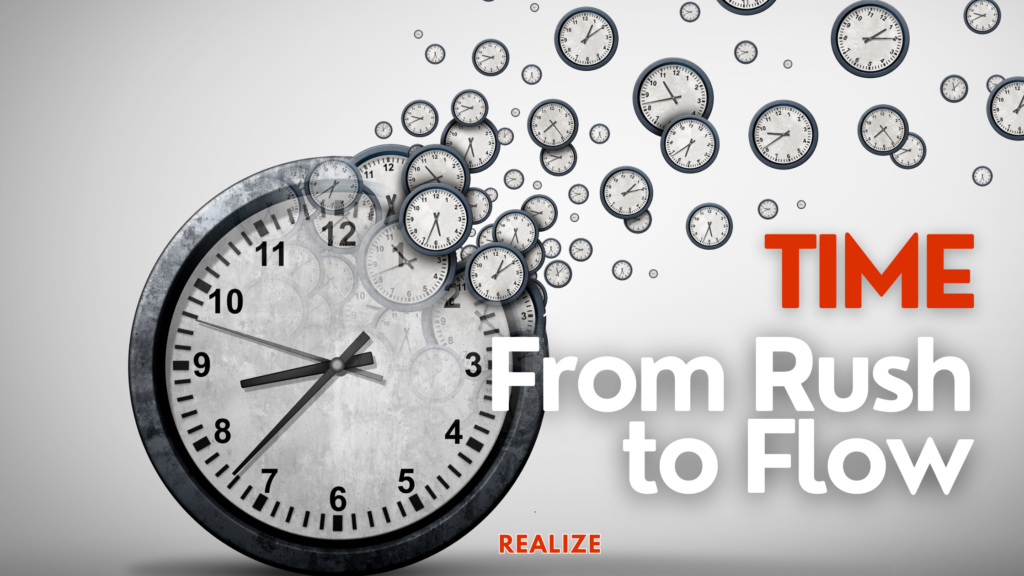
In today’s fast-paced world, it is not uncommon to feel bound by the constraints of time. As we zip through our daily schedules, weekends turn into busy weekdays, filled with an endless list of tasks yet to be accomplished. On supposed ‘free days,’ instead of finding respite, we often find ourselves hurried and frazzled, caught up in the chaos of procrastination and overcommitment. Distractions lurk around every corner, adding fuel to the ever-burning fire of our busyness.
The constant pressure to race against the clock has quietly infiltrated our lives, impacting our well-being and mental peace. A ceaseless buzz of urgency clouds our perceptions, entangling us in a cycle where productivity becomes a deluding metric for our sense of self-worth. Furthermore, the natural daily cycles are overshadowed by constant 24/7 connectivity to the digital world. We often fall into the trap of equating busyness with importance, sacrificing our emotional balance and presence in the moment. When time transforms into a villain, life becomes a breathless chase rather than a lived experience.
Even when we clear our schedules or have the freedom to manage them as we wish, we often feel rushed and pressured to maximize our time. Our attention is fragmented, leading us to constantly second-guess and redirect our actions out of concern for forgetting something or missing out on efficiency. Strangely, I found myself feeling more tense on days off than on busy days. Upon reflecting on this, I realized that on packed days I adhered strictly to the schedule, while on days off I was overwhelmed by the freedom to choose and decide how to best use my time. Improvisation and spontaneity became difficult because my mind was cluttered with thoughts about how I should “get it all done” before I could rest, instead of enjoying the day and being present.
My attention flitted from one incomplete thought to another, bouncing between tasks, starting one, then moving to others without completing them. This mindset would inevitably open the floodgates to self-criticism and a sense of overwhelm. A day off felt like being the white rabbit in Alice in Wonderland, always feeling late, eyes riveted on the clock, and chasing an elusive sense of permission to relax. So, when do we truly relax? After grocery shopping, doing laundry, paying bills, taking the kids out to play, meeting a friend, answering emails, or preparing for the week?
I lacked clarity. I dealt with a jumble of obligations without identifying what was truly urgent, constructive, or unnecessary. My standards were undefined. Looking around me, it became obvious that this self-imposed chaos was neither special nor unique; it had become the norm. Our ability to focus has diminished, leaving us trapped in our thoughts rather than using them productively. The chaos has become so familiar that peace of mind feels foreign. Our busyness acts as a smokescreen to avoid confronting uncomfortable facts. While we are overwhelmed and overstimulated by constant activity, we fail to ask deeper questions or address the growing issues in our lives. We also indulge in content designed to provide quick dopamine hits. It’s easier to scroll through our phones than engage with a book. As we become more passive and less engaged, unable to sustain a train of thought, enjoy the present moment, or reflect, our screens carry us away into a passive existence. Our ability to engage weakens. The result of this ineffective engagement and passive consumption causes mental overload; our minds lose their agility and ease. We become burdened by unprocessed information. We grow mentally numb, emotionally overwhelmed, and our nervous systems are chronically overstimulated. In short, we drain and exhaust ourselves.
How does our mental state influence our relationship with time? While we won’t delve deeply into the complex nature of time—a topic still debated among leading physicists and philosophers—we can challenge some mainstream ideas that seem so concrete that they affect us without us realizing it. What is more accessible for us to explore is how the way we relate to time affects our experience.
An African proverb points us to an entry point in this exploration: “You have watches; we have time.” To navigate the ubiquitous pressures, it is essential to distinguish between chronological and psychological time. Eckhart Tolle masterfully distinguishes between them. Chronological time, or clock time, is a structured sequence used to organize our daily activities; it is predictable, linear, and provides a frame of reference for collaboration. In contrast, psychological time is completely subjective, expanding and contracting based on our perceptions and mental state.
Even the “solidity” of our view of chronological time has been challenged by Albert Einstein’s theory of relativity posing that time is not rigid. There is no single ‘now’ in time, much as the universe bends and stretches. When viewed through this lens, time becomes elastic, influenced by gravity—both literal and metaphorical. Our emotional and mental gravity can slow down or speed up our experience of time, influencing how present and engaged we are. We all drove, possibly listening to some podcast, and experienced a deep immersion in a train of thought. As we returned to our driving and podcast, we realized we had checked out for quite some time, which felt like an instant. We can all agree that when we are having an enjoyable experience, time just flies, but when we are in the throes of pain, it lingers unbearably. What we don’t see as clearly is that what we are feeling is not the circumstances or time itself, but our thinking about them. Enjoyment is quite subjective as well. We don’t all enjoy the same activities. Our enjoyment of activities we typically appreciate also fluctuates with our mindset.
Understanding this fluidity and versatility allows us to challenge our internalized perceptions and redefine our relationship with time. It is not an uncompromising dictator but rather an object whose appreciation flexes with our mental state. This recognizes the power we have to shape how we experience our daily rhythms.
Time is often perceived as a scarce commodity: there is never enough of it. This scarcity mindset traps us in a loop of “never enough,” fostering anxiety and constant dissatisfaction. Transforming this perception involves adopting an abundance mindset, where time becomes a partner rather than an antagonist.
The shift from “I have to” to “I choose to” is transformative. It entails re-evaluating our commitments and aligning them with our values. By understanding that time management is about making conscious choices rather than fulfilling obligations, we invite peace into our lives. We are no longer in debt to time but its collaborator, weaving our own tapestry of experiences.
This shift is subtle but profound. “I have to finish this report” carries the heaviness of compulsion and pressure. “I choose to finish this report because I value clarity and contribution,” carries agency and meaning. The external task is the same; what changes is the inner stance from which we act. Over time, this inner shift reduces the background hum of resentment and quiet resistance that so often fuels burnout.
An abundance relationship with time does not mean cramming more into each day; it means trusting that there is enough space for what is truly essential. It invites us to notice where we are spending time to avoid discomfort—over-scrolling, over-helping, over-working—rather than out of genuine alignment. From this vantage point, saying “no” to what is hollow is not a loss, but a way of making room for what is nourishing.
Moreover, realizing that abundance is a choice inspires us to examine our busyness as a societal construct. It invites us to redefine success not by how much we achieve, but by the quality of our lives. Embracing abundance theory enables us to create a life that values meaningful experiences over mere achievements.
To take this a step further, rather than viewing time as an external entity, we can understand its mental aspect in our relationship with it. In The Big Leap, Gay Hendricks explores the idea of being the Source of time rather than enduring it. By acknowledging how we think about time, we influence our experience of it. Recognizing that our feelings of being rushed or bored are directly linked to the quality of our thoughts, we can move away from the pressure and disappointment that our thoughts about time create. This allows us to let go of the constant judgments we have about time, the incessant commentary weighing on our minds (“I don’t have time, gotta hurry, I can’t do this”…), and embrace the natural peace and spaciousness that come from a mind free of thought turmoil.
It is interesting to note that Flow, a state of deep engagement where time seems to disappear, serves as a gateway to peak performance and optimal living. Psychologist Mihaly Csikszentmihalyi describes this state as one where individuals harness their creativity, optimize their skills, and become fully absorbed and energized by the task at hand. Flow is hindered by our preoccupation with time scarcity but flourishes when we are present, or perhaps ushers us into presence.
Presence is being in the moment with full attention, free from the shackles of past regrets or future anxieties. To unlock flow, we must allow ourselves to enter this state of mind, where gravity and time become malleable, encouraging creativity and joy. In flow, our usual self-conscious commentary quiets down. We are not constantly evaluating, comparing, or measuring. Instead of watching ourselves live, we are simply living. Everyday activities can become portals to this state—cooking, writing, playing with a child, walking, or even answering emails—when our attention is undivided, and our mind is less cluttered with time-based worry.
Exploring Sydney Banks’s insights, which emphasized the human mind’s potential to transcend its boundaries, offers pathways to achieve this. Banks pointed out that our feeling of being stuck in the past or anxious about the future is created by thoughts in the moment. When we see that clearly, the past and future lose their grip. We’re not bound by time in the same way anymore—we’re living from a deeper, timeless intelligence underneath our thinking.
From this vantage point, flow is not something we have to manufacture through willpower or technique; it arises naturally when excessive thinking settles. Realizing that our moment-to-moment experience is thought-created softens the pressure to control circumstances. Instead of trying to wrestle our schedule into perfection, we begin to look in a different direction: toward the quality of mind from which we meet each moment. As our understanding deepens, we find that glimpses of flow and presence become more frequent and more accessible, not because life has become simpler, but because our relationship with thought—and thus with time—has fundamentally changed.
The journey from rush to flow relies on actively engaging with our perceptions and choices. The Realization Catalyst Formula, composed of Envision, Listen, and Play, serves as a guide for cultivating a life of presence and peace.
– Envision: we create a vision for ourselves where we are both effective and free from the stress of constant time constraints or the dread of endless, taxing situations. What does effortless ease look like? How does it feel to navigate the day with grace and purpose?
– Listen: By paying attention to our inner voices and what they’ve been telling us, we can more easily connect with our internal wisdom and intuition. This clarity helps us reflect on our current commitments and assess how aligned they are with our pursuits, interests, and values. Listening enables us to recognize when time-related stress arises and offers us the opportunity to be free.
– Play: Rediscover joy by engaging in activities with curiosity and wonder. Play shifts the focus from achievement to enjoyment, fostering a mindset in which time expands to accommodate our passions and needs.
March is an invitation to walk through our days with renewed intention, challenging existing perceptions of time-related pressures. By adopting this formula, we cultivate a space where time becomes an ally in our quest for personal fulfillment and peace. Join us each week on Mindset Mondays in the Realization Hub as we journey into a harmonious existence, embracing the dance with time, presence, and well-being.



Most people are under the impression that they are stuck in a chaotic and uninspiring life. At Realize, with life coaching, we guide our clients through a proven framework to confidently build a life where they thrive.


Florence Doisneau
Certified Life Coach
954.826.9172
florence@realizeunlimited.com